April 7, 2025

Why Can Plasma-Sprayed Nickel Mesh Enhance Hydrogen Production Efficiency?
Against the background of the growing global demand for clean energy, hydrogen has garnered significant attention as an ideal clean energy source. Water electrolysis is currently a key industrial method for hydrogen production, and during this process, the performance of electrodes fundamentally impacts hydrogen production efficiency.
Among these, improving the performance of nickel mesh electrodes has become a focal point in industry research, with plasma-sprayed porous nickel mesh technology demonstrating unique advantages in this field.
Principles of Hydrogen Production via Water Electrolysis
Hydrogen production through water electrolysis essentially refers to the process of water ionization and recombination under an electric current in an alkaline electrolyte environment.
In practical industrial hydrogen production operations, an external DC power supply is applied to the electrolyzer. Under suitable conditions such as electrolyte concentration (typically potassium hydroxide or sodium hydroxide solution), temperature, and pressure, the electrode reactions are driven to proceed continuously, enabling large-scale water splitting to produce hydrogen.

Moreover, to improve hydrogen production efficiency, industries also optimize the structural design of the electrolyzer, the selection of electrode materials, and electrolysis process parameters (such as current density and electrolyte flow rate).
For example, using electrode materials with high catalytic activity (such as specially treated nickel mesh electrodes) can reduce the activation energy of the reaction and accelerate the electrode reaction rate. A reasonable electrolyte flow rate helps remove generated gases and heat, maintaining a stable environment within the electrolyzer, thereby enhancing the overall efficiency of the hydrogen production process.
How Does Plasma-Sprayed Nickel Mesh Improve Hydrogen Production Efficiency?
1 Increased Adsorption Surface Area
In traditional hydrogen production, nickel mesh plays a critical role as a hydrogen evolution cathode. To enhance its performance, a nickel-aluminum alloy is first sprayed onto the nickel mesh surface, which is then treated with a concentrated sodium hydroxide solution.
The aluminum reacts with the sodium hydroxide and dissolves, leaving behind numerous micropores. This three-dimensional microporous structure significantly increases the adsorption surface area of the nickel mesh. According to electrochemical principles, a larger adsorption surface area provides more active sites for the reaction. During water electrolysis, more water molecules can adsorb onto the electrode surface, thereby accelerating the reaction rate.
2 Facilitating Oxygen Release
In alkaline water electrolysis, if the oxygen generated at the anode cannot be released promptly, it forms a barrier layer on the electrode surface, inhibiting subsequent electrolysis reactions. The microporous characteristics of the coating structure formed by plasma-sprayed porous nickel mesh facilitate the release and dispersion of oxygen generated during electrolysis. This prevents oxygen accumulation on the electrode surface, improving the overall efficiency of the electrolysis process.
3 Strong Bonding Strength and Stability
Unlike conventional techniques that coat metal or ceramic layers on nickel mesh surfaces, the structure formed by plasma-sprayed porous nickel mesh technology exhibits superior stability. Before plasma spraying, the substrate surface undergoes sandblasting, which activates the nickel mesh substrate surface, enhancing the bonding strength between layers. This ensures the structural integrity of the electrode and guarantees long-term stable operation during actual water electrolysis for hydrogen production.
4 Reduced Internal Resistance
After spraying the nickel-aluminum alloy coating on the nickel mesh surface, its surface area and roughness are significantly improved. The larger adsorption surface area and favorable microstructure also help reduce the electrode’s internal resistance. According to Ohm’s Law, in water electrolysis for hydrogen production, lower internal resistance means a smaller voltage drop, enabling higher electrolysis efficiency with lower energy consumption.
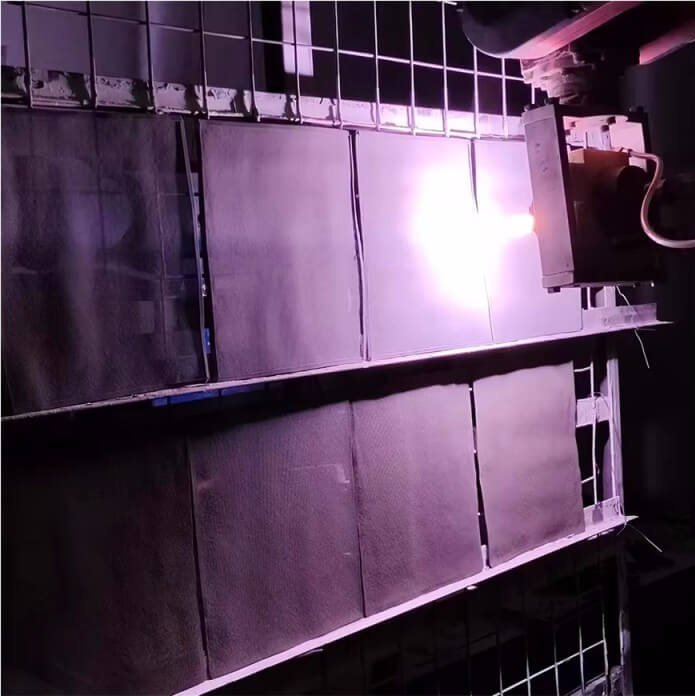
Process Improvements in Plasma-Sprayed Porous Nickel Mesh
1 Nickel Mesh Substrate Treatment
Due to the flexible wire mesh structure of nickel mesh, conventional coating methods often lead to overall curling, unevenness, and poor adhesion between the coating and the substrate. Therefore, nickel mesh is typically sandblasted before spraying.
Specific sandblasting conditions activate the substrate surface, which not only enhances the bonding strength between the coating and the substrate during subsequent spraying but also helps maintain the overall flatness of the nickel mesh structure.
2 Optimization of Plasma Spraying Parameters
When plasma spraying nickel mesh, parameters such as spraying distance, spraying current, and powder feed rate must be strictly controlled. Industrially common parameters include
spraying distance of 90–130 mm,
spraying current of 510–570 A,
powder feed rate of 1–7 r/min.
Precise control of these parameters ensures that the material deposited on the nickel mesh substrate is in a fully or semi-molten state, guaranteeing strong adhesion between the substrate and the coating layer. It also prevents substrate deformation caused by uneven or excessive heating, extending the service life of the nickel mesh and indirectly improving hydrogen production efficiency.
Conclusion
In summary, plasma-sprayed porous nickel mesh technology optimizes the structure of nickel mesh electrodes, enhancing adsorption surface area, oxygen release, bonding strength, and internal resistance. Process improvements further ensure electrode stability and service life, effectively boosting the efficiency of industrial water electrolysis for hydrogen production. It provides robust technical support for the development of clean energy.
NHGT is a professional supplier of Raney nickel-coated mesh. We’ve provided technical and physical support to many institutes, laboratories, and electrolyzer producers. If you’re looking for nickel meshes for your energy projects, please feel free to contact us for any inquiries.
Leave A Comment Cancel reply
Recent Posts
- Does Nickel Mesh Actually Dissolve in an AEM Electrolyzer?
- The Technical Edge of Raney Nickel Coatings on Mesh
- Customization Options for Nickel Mesh: A Comprehensive Guide for Buyers
- Nickel Mesh vs. Nickel Foam for Hydrogen Electrolyzers: A Detailed Comparison
- Winter Operation of Nickel Mesh Electrodes: Strategies for Freeze Protection in Low-Temperature Electrolyzers
Recent Comments


Tags
- 100 mesh fine nickel mesh
- alkaline electrolyser
- alkaline electrolysers
- alkaline electrolysis hydrogen production
- alkaline electrolyzer electrode
- alkaline water electrolysis for hydrogen production
- Alkaline Water Electrolysis Hydrogen Production
- alkaline water electrolysis system
- application of nickel mesh
- AWE
- AWE hydrogen production
- B2B nickel mesh checklist
- buy nickel expanded mesh
- buy woven nickel wire mesh
- cathode material for electrolysis
- characteristics of nickel mesh
- China nickel expanded mesh
- China nickel mesh
- China nickel wire knitted mesh
- China nickel wire woven mesh
- coated nickel mesh
- custom expanded nickel mesh
- customizing nickel mesh
- does nickel mesh dissolve in an AEM electrolyzer
- electrode materials
- electrode materials for alkaline electrolyzer
- electrodes for water electrolysis
- electrolyser manufacturer
- electrolysers
- electrolysis of water
- electrolyzer manufacturer
- expanded nickel metal
- factors affecting performance of electrolyzer
- fine nickel mesh
- fuel cell mesh
- fuel cell nickel mesh
- green hydrogen
- green hydrogen application
- green hydrogen energy
- green hydrogen market
- high quality nickel mesh
- hydrogen ammonia synthesis project
- hydrogen energy
- hydrogen energy application
- hydrogen energy prospect
- hydrogen engery
- hydrogen fuel cell
- hydrogen fuel cell vehicle
- hydrogen major projects
- hydrogen production efficiency
- hydrogen production electrolyzer
- hydrogen production industry
- hydrogen production nickel mesh
- identify nickel wire mesh quality
- ni based electrode
- nickel-based catalysts
- nickel-plated wire mesh
- nickel 200 vs nickel 201
- nickel alloy composition
- nickel alloy mesh
- nickel electrodes
- nickel expanded mesh
- nickel foam
- nickel foam for AEM electrolyser
- nickel foam mesh
- nickel knitted wire mesh rolls
- nickel knitted wire mesh sizes
- nickel knitted wire mesh suppliers
- nickel mesh
- nickel mesh application in aerospace
- nickel mesh application percentage
- nickel mesh applications
- nickel mesh as catalyst
- nickel mesh corrosion and oxidation resistance
- nickel mesh cost
- nickel mesh cost analysis
- nickel mesh cost in hydrogen produciton
- nickel mesh customization
- nickel mesh deals
- nickel mesh demand
- nickel mesh demand in China
- nickel mesh electrode
- nickel mesh electrode for hydrogen production
- nickel mesh electrode with Raney nickel treatment
- nickel meshes
- nickel meshes as anodes
- nickel meshes for hydrogen production
- nickel mesh for alkaline electrolyzer
- nickel mesh for clean energy
- nickel mesh for flow battery
- nickel mesh for hydrogen production
- nickel mesh for oil separation
- nickel mesh for PEM electrolyzer
- nickel mesh geometry
- nickel mesh in hydrogen production
- nickel mesh manufacturer
- nickel mesh market prospect
- nickel mesh mechanical properties
- nickel mesh opening numbers
- nickel mesh orders
- nickel mesh performance
- nickel mesh procurement strategy
- nickel mesh production process
- nickel mesh production technology
- nickel mesh quality inspection
- nickel mesh size
- nickel mesh size suitable for hydrogen production
- nickel mesh status in China
- nickel mesh supplier
- nickel mesh surface area
- nickel mesh surface treatment
- nickel mesh treatment
- nickel mesh vs nickel foam
- nickel mesh wire diameter
- nickel price
- nickel purity
- nickel wire cloth
- nickel wire cloth manufacturer
- nickel wire cloth sample
- nickel wire mesh
- nickel wire mesh for hydrogen fuel cell
- nickel wire mesh for hydrogen production
- nickel wire mesh manufacturers
- nickel wire mesh price
- nickel wire mesh price affecting factors
- nickel wire mesh prices
- nickel wire mesh production
- nickel wire mesh quality
- nickel woven wire mesh
- ni foam
- ni mesh
- PEM water electrolysis
- pem water electrolysis system
- performance of electrolyzer
- plain weave nickel wire mesh
- plasma sprayed nickel mesh
- plasma spray on nickel mesh
- policy support
- pure nickel mesh filters
- pure nickel wire mesh
- raney nickel
- raney nickel attached to nickel mesh
- raney nickel catalyst for alk electrolyzer
- Raney nickel coating technical edge
- raney nickel mesh
- raney nickel mesh for hydrogen production
- raney nickel plasma spray
- role of nickel mesh in hydrogen production
- seawater electrolysis hydrogen production device
- significance of hydrogen energy
- status of hydrogen production electrolyzer
- structure of alkaline electrolyser
- suitable nickel mesh for specific application
- twill weave nickel wire mesh
- ultra thin nickel mesh
- verify nickel mesh purity
- water electrolysis
- water electrolysis electrode material
- water electrolysis material
- wholesale nickel wire knitted mesh
- wholesale nickel wire mesh
- winter operation of nickel mesh electrodes
- wire mesh gas filters
- woven nickel mesh
- woven nickel wire mesh